
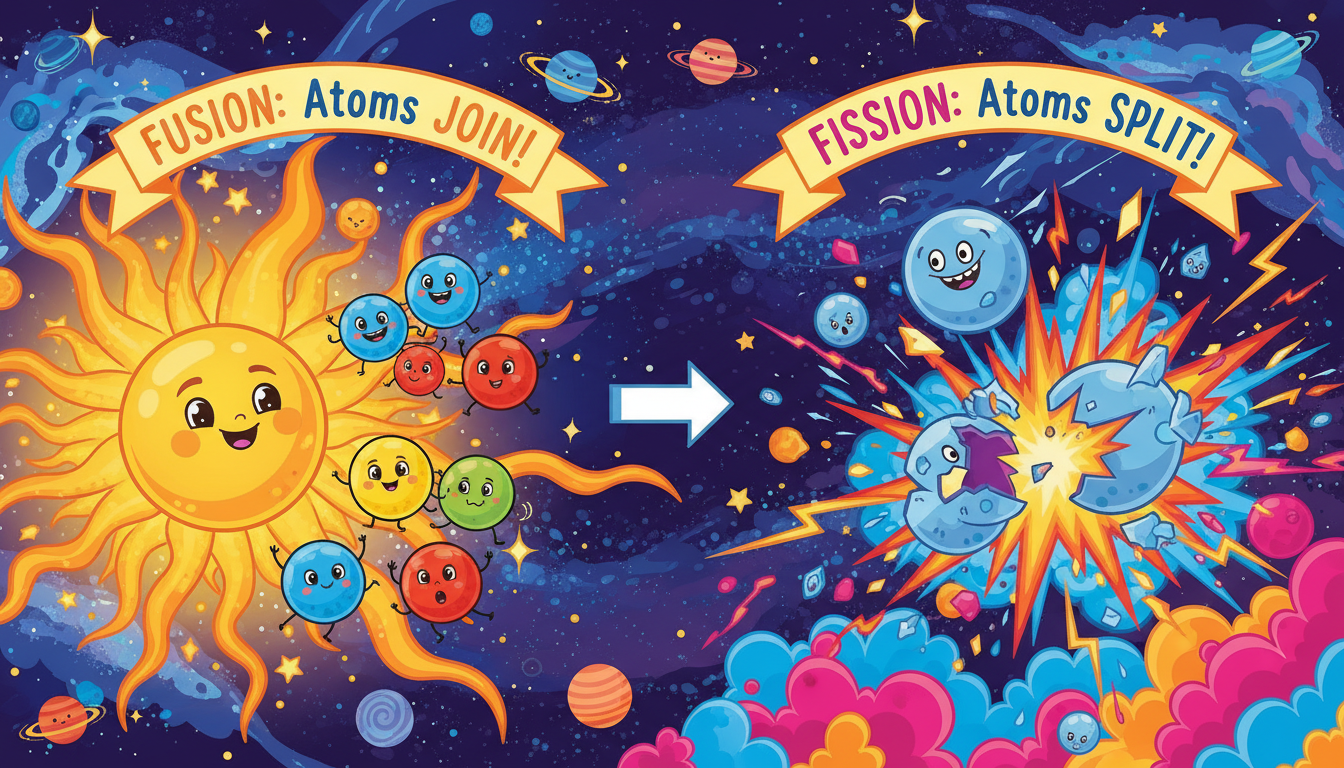
Understanding Nuclear Fission and Fusion: Key Concepts Explained
Quick Answer
Nuclear fission occurs when certain atoms break into fragments after being struck by neutrons, while nuclear fusion involves smaller nuclei combining, releasing energy. Question 10's correct answer is 'a', and for question 11, 'd' is correct as it encompasses all true statements about fusion.
Let's dive deeper into the concepts of nuclear fission and fusion to clarify why specific answers are correct for these scientific questions.
### Understanding Nuclear Fission
Fission is a nuclear reaction in which a large atomic nucleus splits into smaller parts, often producing free neutrons and photons (in the form of gamma rays). This process typically involves uranium or plutonium isotopes. Here's a breakdown of why only option 'a' is correct for question 10:
- **Option a** states that 'certain atoms break into fragments when struck by neutrons.' This is accurate as neutrons collide with heavy nuclei, causing them to become unstable and split.
- **Option b** says 'a chain reaction cannot occur.' This is incorrect. In fact, fission can lead to a chain reaction, where the neutrons released can initiate further fission events, which is the principle behind nuclear reactors and atomic bombs.
- **Option c** mentions that 'energy is absorbed.' This is false because, during fission, energy is released, not absorbed. The splitting of the nucleus releases a significant amount of energy due to the conversion of mass into energy, as described by Einstein's equation, E=mc².
- **Option d** ('all of the above') cannot be correct because, as we established, options b and c are false.
Thus, option 'a' is the only correct answer for question 10.
### Understanding Nuclear Fusion
Moving on to nuclear fusion, this process involves the merging of smaller atomic nuclei to form a heavier nucleus, which releases energy. It's the process that powers stars, including our sun. In question 11, 'd' is correct because:
- **Option a** states that fusion occurs when large nuclei fuse together, which is somewhat misleading but can be interpreted correctly as smaller nuclei (like hydrogen isotopes) can fuse to form helium.
- **Option b** asserts that fusion takes place in the sun. This is true; the sun’s energy comes from the fusion of hydrogen nuclei into helium, releasing vast amounts of energy in the process.
- **Option c** indicates that fusion generally releases energy, which is correct. The fusion process releases energy as a result of the mass difference between the reactants and the products, similar to fission but with different mechanics.
When we combine these truths, option 'd' ('all of the above') accurately reflects the nature of nuclear fusion, thus making it the correct answer for question 11.
### Real-World Applications
Understanding these processes is crucial not only in academic settings but also in real-world applications. Nuclear fission is used in power generation, while nuclear fusion holds promise for clean energy solutions, potentially providing a nearly limitless source of energy without the radioactive waste associated with fission.
By grasping these concepts, students can better appreciate the complexities of nuclear reactions and their implications for energy production and scientific advancement.
Was this answer helpful?